Reading
At St Paul’s school, we want every child to discover the pleasure and power of language and to develop a lifelong love of books and reading for pleasure.
We believe that learning to read is one of the most important foundations of a child's education.
Our approach to reading is built on firm foundations. We recognise that becoming a successful reader involves much more than learning to decode words. Children need to develop strong oral language, vocabulary and listening skills alongside secure phonics knowledge, fluency and comprehension.
Our approach is informed by the Reading Framework (2023), which emphasises the importance of talk, stories, vocabulary and systematic synthetic phonics in developing successful readers.
EYFS – Building the foundations for reading
In EYFS, we focus first on developing the language and communication skills that underpin reading.
Children are immersed in a language-rich environment where they have frequent opportunities to talk, listen, sing, share stories and learn new vocabulary. We recognise that the development of spoken language provides an essential foundation for later reading and writing.
Rhyme Time Poetry Basket
Each week, children are introduced to and learn a new rhyme or poem. Through repetition, recitation and enjoyment, children develop their awareness of rhythm, rhyme and the sounds and patterns of spoken language. The Reading Framework highlights how the predictability and repetition of rhymes help children to remember and reuse new words and phrases.
Nursery Rhymes and Songs
We regularly sing traditional nursery rhymes and songs together. Repetition helps children develop their confidence with language, remember new vocabulary and become familiar with the patterns and rhythms of spoken language.
Concept Cat
Each week, Concept Cat introduces children to a new word. Through discussion, repetition and opportunities to use the word in different contexts, we gradually build children's vocabulary and understanding of language.
Sharing Stories and Books
Children regularly listen to and talk about high-quality stories, poems and non-fiction texts. Adults model rich language and encourage children to respond, predict, question and share their ideas. Through stories and books, children encounter new vocabulary, experiences and ideas beyond their immediate world.
Little Wandle Phonics – learning to decode
Once children begin formal phonics teaching, they follow Little Wandle Letters and Sounds Revised through daily, systematic phonics sessions.
Children are explicitly taught the relationship between letters and sounds and learn to blend sounds to read words. They practise applying their developing phonics knowledge through carefully matched reading books.
We understand that secure decoding is a fundamental foundation for fluent reading. Children are given regular opportunities to practise the knowledge and skills they have been taught so that decoding becomes increasingly accurate and automatic.
Reading the same book three times
As part of the Little Wandle approach, children read the same carefully matched book three times, with each reading having a different focus. This gives children the opportunity to develop their reading step by step rather than having to focus on everything at once.
- Decoding – Can I read the words?
On the first read, the focus is on accurate decoding. Children apply their phonics knowledge to read the words in the book, building confidence and accuracy. - Prosody – Can I read it like a reader?
On the second read, the focus moves to prosody – reading with appropriate expression, phrasing, rhythm and intonation. As the words become more familiar, children can begin to read more fluently and expressively. - Comprehension – Do I understand what I have read?
On the third read, the focus is on comprehension. With decoding becoming more secure, children can give more attention to the meaning of the text. They discuss what they have read, answer questions, make predictions and develop their understanding of characters, events and ideas.
This repeated reading approach helps children to experience success and develop accuracy, fluency and understanding. It also helps children develop the confidence and automaticity they need to become increasingly independent readers.
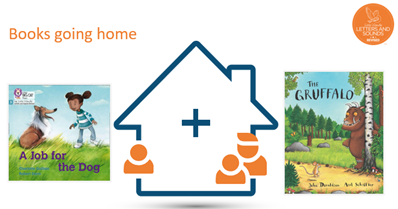
After reading the book three times in school, children will bring their book home to share their success. Children will also bring home a ‘reading for pleasure’ book for an adult at home to read to them.
Where children need additional support, we provide opportunities to revisit and practise the specific phonics knowledge they have not yet secured. Our aim is to identify gaps early and provide the additional practice children need to keep up.
Learning to decode is only the beginning of becoming a reader.
The importance of reading fluency
As children progress through school, we continue to develop fluency, vocabulary and comprehension.
We are excited to be in the process of expanding the Little Wandle systematic approach to teaching reading fluency into Year 3 and 4.
The Reading Framework (2023) identifies the importance of explicitly teaching fluency to ensure that children are reading with accuracy, automaticity, understanding and expression.
The three elements of fluency are:
- Accuracy: children are increasingly able to recognise many words on sight and read them with increased accuracy. As well as accurate decoding, there should not be any omissions, additions or transpositions as they read.
- Rate: Children need to develop a natural-sounding pace as they read aloud. A slow, halting speed without flow will impact comprehension. Conversely, meaning is lost if a child rattles through the text at breakneck speed.
- Prosody: This is about the musicality of reading aloud – developing an expressive read. The focus here is on tone, rhythm, dynamics and phrasing.
Throughout KS2 we teach children to become active readers who can retrieve information, make inferences, predict, summarise, ask questions and explain their thinking. They are encouraged to discuss different interpretations and support their ideas with evidence from the text.
Our Literacy Tree curriculum places high-quality children's literature at the heart of English. Carefully selected texts provide opportunities to develop vocabulary, explore ideas, discuss characters and themes, and encounter different cultures, experiences and perspectives.
Reading is not confined to English lessons. We want children to understand that reading opens doors to learning across the whole curriculum.
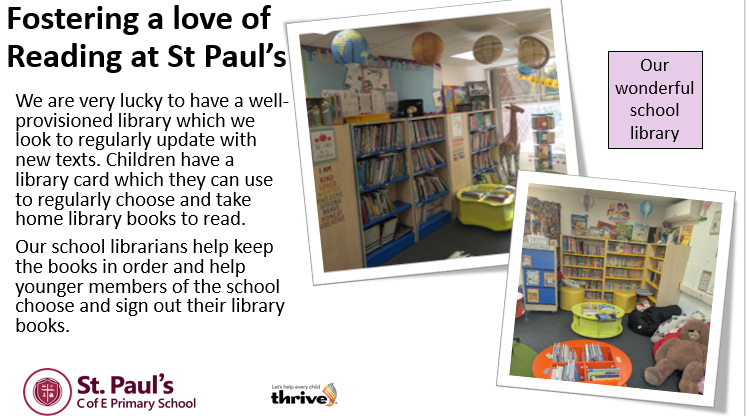
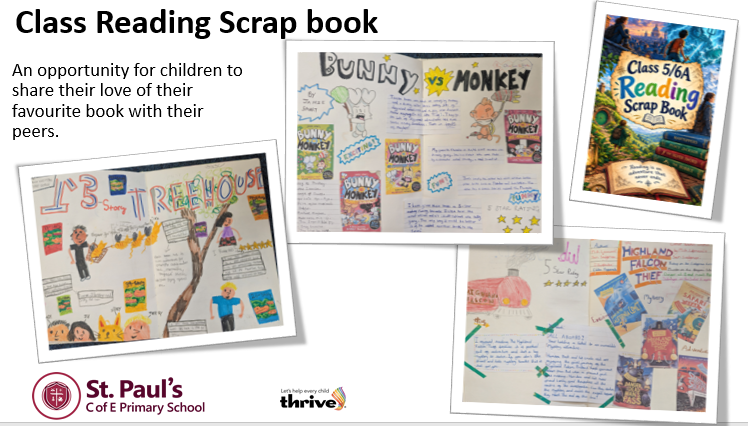
Children encounter a wide range of authors, genres and texts throughout their time at St Paul's school. We want them to discover favourite authors and books, recommend books to others and develop the confidence to choose reading material for themselves.
Our ultimate aim is for every child to leave Year 6 as a fluent, confident and enthusiastic reader.